
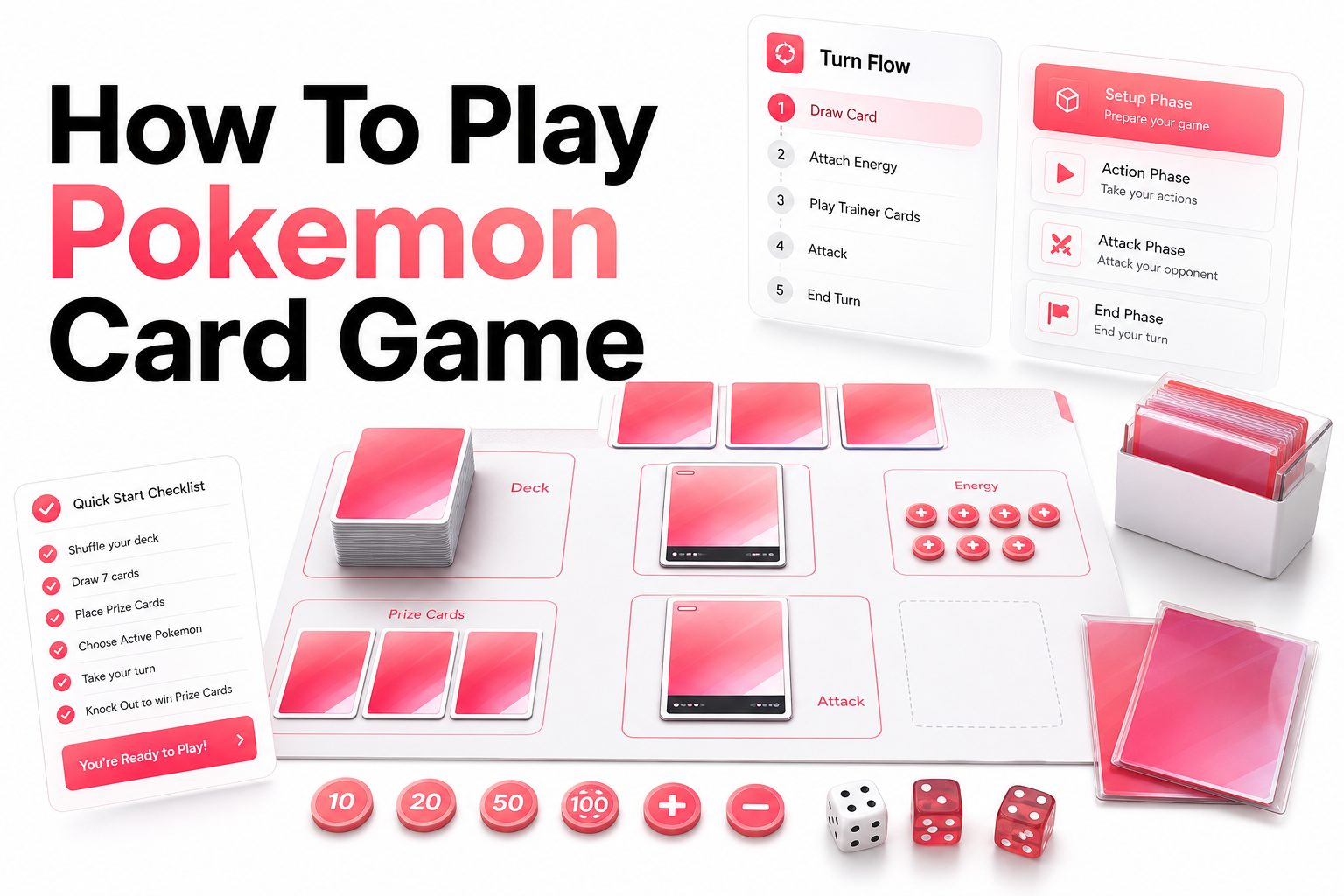
Learning how to play pokemon card game is much easier when you see the match as a simple back-and-forth battle. Each player builds a 60-card deck, sends Pokemon into play, attaches Energy, uses Trainer cards, and tries to take Prize cards by Knocking Out the opponent’s Pokemon.
The game has strategy, but your first few matches should focus on flow rather than perfect decisions. Once you know where cards go, what happens during a turn, and how attacks work, the rest starts to feel natural. This guide walks through the rules in plain English so you can sit down with a starter deck and play with confidence.
What You Need Before Playing
A normal Pokemon TCG match uses two 60-card decks, damage counters, status markers, a coin or die for flips, and six Prize cards for each player. Most starter decks include everything needed, making them the easiest choice for beginners.
You also need a flat play area with room for your Active Pokemon, Benched Pokemon, deck, discard pile, Prize cards, and Lost Zone if a card mentions it. Keeping the layout organized helps both players follow the game state without confusion.
Basic Goal of the Game
The main goal is to take all six Prize cards before your opponent does. You take Prize cards when you Knock Out an opposing Pokemon, although some powerful Pokemon give up two or more Prize cards when defeated.
You can also win if your opponent has no Pokemon left in play or cannot draw a card at the start of their turn. Most games, however, are won by smart attacks, steady Energy use, and choosing the right targets.
Beginner Setup Checklist
- Use a complete 60-card deck.
- Shuffle your deck thoroughly.
- Draw seven cards for your opening hand.
- Put one Basic Pokemon face down as your Active Pokemon.
- Place up to five Basic Pokemon on your Bench.
- Set aside six Prize cards face down.
- Flip a coin to decide who goes first.
- Reveal Active and Benched Pokemon before the first turn begins.
Pokemon Card Types
Pokemon cards are the creatures you battle with. Basic Pokemon can be played directly from your hand, while Stage 1 and Stage 2 Pokemon evolve from earlier forms. Evolution gives stronger attacks, more HP, and better abilities.
Trainer cards support your strategy in different ways. Items are usually quick effects, Supporters are powerful but limited to one per turn, Tools attach to Pokemon, and Stadiums stay in play until replaced. Energy cards pay attack costs and power your board.
How to Set Up the Playing Field
Your Active Pokemon sits in the front and is the one that attacks or receives attacks. Your Bench holds backup Pokemon that may evolve, receive Energy, or move into the Active Spot later.
Your deck stays face down, and your discard pile is face up. Prize cards remain face down until earned. This layout matters because many card effects refer to specific zones, so good habits prevent mistakes during longer games.
Quick Card Zone Reference
Zone | What It Means
Active Spot | The Pokemon currently battling
Bench | Up to five backup Pokemon
Deck | Your face-down draw pile
Discard Pile | Used cards and Knocked Out Pokemon
Prize Cards | Six face-down rewards
Hand | Cards you can play from
Lost Zone | Special removed area used by certain cards
Starting the Match
After shuffling, each player draws seven cards. If you have no Basic Pokemon, reveal your hand, shuffle it back into your deck, and draw again. Your opponent may draw an extra card for each time you repeat this process.
Once both players have Basic Pokemon ready, place Prize cards face down. The player going first begins the game, but the first player cannot attack on their first turn under current standard play rules.
What Happens During a Turn
Each turn starts by drawing one card. After that, you may play Basic Pokemon, evolve eligible Pokemon, attach one Energy, use Trainer cards, retreat, and activate abilities if their conditions allow it.
Your turn usually ends when your Active Pokemon attacks. After damage and effects are resolved, check whether any Pokemon were Knocked Out. If a Knock Out happens, the attacking player takes the correct number of Prize cards.
Turn Flow Tips
- Draw before doing anything else.
- Attach only one Energy per turn unless a card effect says otherwise.
- Use Supporter cards carefully because you only get one each turn.
- Evolve Pokemon that have been in play since the start of your turn.
- Attack last because attacking ends your turn.
- Check Weakness, Resistance, and Retreat Cost when planning moves.
How Energy Works
Energy cards are what let Pokemon attack. If an attack costs one Fire Energy and one Colorless Energy, you need at least one Fire Energy plus any other Energy attached to that Pokemon.
Most decks use Energy types that match their main attackers. Some decks use special Energy cards for extra effects, but beginners should start with basic Energy until they are comfortable with attack costs and timing.
How Attacking Works
To attack, your Active Pokemon must have the required Energy attached. Choose one listed attack, apply its damage and effects, then place damage counters on the opponent’s Active Pokemon. Ten damage equals one damage counter.
Some attacks cause status conditions, move Energy, draw cards, or affect Benched Pokemon. Always read the full attack text before choosing it, because the best move is not always the one with the highest printed damage.
Common Attack Symbols
- Grass Energy supports many healing and status strategies.
- Fire Energy often powers high-damage attacks.
- Water Energy appears in flexible setup decks.
- Lightning Energy often favors speed and pressure.
- Psychic Energy may focus on effects and counters.
- Fighting Energy is common in direct, sturdy attackers.
- Darkness and Metal Energy support distinct deck styles.
- Colorless costs can be paid with any Energy type.
Evolving Pokemon
Evolution makes your Pokemon stronger, but it follows timing rules. You cannot evolve a Pokemon on the same turn it was played, and you cannot evolve on the first turn of the game.
To evolve, place the correct Stage 1 card on top of its Basic Pokemon, or place Stage 2 on top of its matching Stage 1. Evolution keeps attached Energy and damage but usually removes Special Conditions.
Using Trainer Cards Well
Trainer cards often decide the pace of a match. Search cards help find Pokemon, draw Supporters refresh your hand, switching cards move Pokemon around, and Tools improve attackers or protect important targets.
A good beginner habit is to play cards with purpose. Before using a draw card, consider whether you need to search first. Before using a switch effect, check whether retreating with Energy would be better.
Trainer Card Comparison
Card Type | Basic Rule | Beginner Use
Item | Play many per turn | Search, switch, heal, or disrupt
Supporter | One per turn | Draw cards or make major plays
Stadium | One stays in play | Gives both players a field effect
Tool | Attach to Pokemon | Adds protection or extra power
Retreating and Switching
Retreating lets you move your Active Pokemon to the Bench by discarding Energy equal to its Retreat Cost. You can retreat only once per turn, so timing matters when your Active Pokemon is damaged or stuck.
Switching effects are different because they come from cards. A switch card may move your Pokemon without paying Retreat Cost. This can save Energy and create stronger turns, especially when preparing a fresh attacker.
Special Conditions
Special Conditions affect the Active Pokemon. The common ones are Asleep, Burned, Confused, Paralyzed, and Poisoned. They can stop attacks, add damage, or make decisions riskier depending on the condition.
Most Special Conditions go away when a Pokemon moves to the Bench or evolves. This makes retreating, switching, and evolving useful defensive options, not just ways to change attackers.
Special Condition Basics
- Asleep: The Pokemon cannot attack or retreat unless it wakes up by coin flip.
- Burned: The Pokemon takes damage between turns unless a coin flip removes it.
- Confused: Attacking may fail and damage the attacking Pokemon.
- Paralyzed: The Pokemon cannot attack or retreat for one turn.
- Poisoned: The Pokemon takes damage between turns until removed.
Prize Cards and Knock Outs
When you Knock Out an opposing Pokemon, you take Prize cards. Most regular Pokemon give one Prize card, while Pokemon ex and similar powerful cards often give two or more. Always check the card text.
Prize mapping is a key strategy. If your opponent uses strong multi-Prize Pokemon, you may need fewer Knock Outs to win. If they use single-Prize Pokemon, you may need to defeat more targets.
Building Your First Deck
A legal deck has exactly 60 cards, and you can usually include up to four copies of a card with the same name, except basic Energy. Starter decks already follow these rules and are ideal for learning.
When you build your own deck, avoid adding too many different Pokemon lines. A focused deck draws better and sets up faster. Beginners often do well with a clear main attacker, support Pokemon, Trainer cards, and enough Energy.
Simple Beginner Deck Structure
- 12 to 18 Pokemon cards
- 28 to 34 Trainer cards
- 10 to 14 Energy cards
- 2 to 3 main attackers
- Several draw Supporters
- Search cards for Basic Pokemon and Evolution pieces
- Switching cards for board control
Common Beginner Mistakes
Many new players attach Energy to too many different Pokemon. It is usually better to power one main attacker while preparing a backup. Scattered Energy can leave you unable to attack effectively when pressure rises.
Another common mistake is evolving or playing cards too quickly. Sometimes holding a card for one turn gives you better options. Good players think about the next turn, not only the strongest move available right now.
Reading Cards During Play
Pokemon TCG cards are written in a specific order. HP sits near the top, attacks are in the middle, and Weakness, Resistance, and Retreat Cost appear at the bottom. These details affect almost every turn.
When a card’s text conflicts with a general rule, the card text usually wins. This is why careful reading matters. If a card says you may attach extra Energy, draw more cards, or ignore a cost, follow that effect.
Important Reading Habits
- Check whether an effect says “may” or requires the action.
- Confirm whether an attack affects Active or Benched Pokemon.
- Look for once-per-turn limits on abilities.
- Read whether a card works before or after attacking.
- Check if damage is changed by Weakness or Resistance.
- Notice whether a card discards Energy as part of its attack.
How Weakness and Resistance Work
Weakness increases damage when the attacking Pokemon’s type matches the defender’s Weakness. Many cards use x2 Weakness, which can turn a modest attack into a Knock Out. Always check before announcing final damage.
Resistance reduces damage when listed on the defending Pokemon. Not every card has Resistance, but when it appears, it can change your best attack choice. Apply damage changes after reading the attack and relevant effects.
Playing Your First Practice Game
For your first game, use two starter decks and play with hands revealed if both players agree. This removes pressure and makes it easier to explain decisions, card timing, and attack choices.
Focus on completing full turns correctly. Draw, prepare your board, attach Energy, consider Trainers, then attack. After a few matches, the rhythm becomes familiar, and you can start thinking more about strategy.
First Game Tips
- Play slowly and talk through each step.
- Keep damage counters neat and visible.
- Ask before touching your opponent’s cards.
- Read attacks aloud until both players know them.
- Do not worry about perfect deck strategy at first.
- Restart after a few turns if setup mistakes make learning harder.
Playing Pokemon TCG Live
Pokemon TCG Live is the official digital way to practice the game. It handles rules, damage, Energy costs, and turn timing automatically, which can help beginners learn correct sequencing faster.
Digital play is useful, but physical matches teach habits the app handles for you. If you plan to play at local shops, practice shuffling, Prize setup, damage tracking, and clear communication with real cards.
Casual Play Versus Tournament Play
Casual games are flexible. You can use older cards, adjust decks, pause to read rules, and learn at your own pace. This is the best setting for families, collectors, and first-time players.
Tournament play follows stricter formats and card legality rules. Standard format is the most common official format, and legal cards are based on regulation marks and current Pokemon rules documents.
Casual and Tournament Comparison
Format | Best For | Main Concern
Casual Play | Learning and fun matches | Agree on decks before playing
Standard Format | Local events and official play | Use currently legal cards
Expanded Format | Larger card pool | More complex combinations
Theme or Starter Deck Play | Beginners | Balanced learning experience
Basic Strategy for Beginners
Strong play starts with setup. Get multiple Basic Pokemon into play early, attach Energy every turn when possible, and use draw cards to avoid running out of options. A slow start often gives your opponent control.
You should also protect your best attacker. If a Pokemon needs several Energy to attack, prepare it before moving it Active. Let smaller Pokemon absorb pressure while your main attacker gets ready on the Bench.
Improving After Your First Matches
After each game, look at which cards were useful and which stayed stuck in your hand. Cards that often help your setup should stay. Cards that rarely matter may need to be replaced.
You can also learn by watching local players or official matches. Pay attention to how experienced players sequence search cards, draw Supporters, Energy attachments, and attacks. Small timing choices often create big advantages.
Ways to Improve Faster
- Play the same deck several times before changing it.
- Track games where you miss Energy attachments.
- Notice which Pokemon are Knocked Out too easily.
- Add more draw cards if your hand often runs empty.
- Practice Prize counting during every match.
- Read official card rulings when an effect feels unclear.
- Visit [Internal Link: Pokemon TCG Deck Building Tips] for deeper deck advice.
Buying Cards for Learning
For new players, preconstructed decks are better than random booster packs. They include a playable 60-card deck, while booster packs are mainly for collecting, upgrading, or finding specific cards over time.
Once you know your favorite type or strategy, upgrade slowly. Buy singles or structured products that support your deck. Random packs can be fun, but they are not the most reliable way to build a consistent list.
Teaching Kids and New Players
The easiest way to teach is to remove extra complexity at first. Start with Basic Pokemon, Energy attachments, simple attacks, and Prize cards. Add evolution, abilities, and Supporter timing once the first turns make sense.
Let new players make visible choices. Ask which Pokemon they want to power up or whether they want to attack or retreat. This builds confidence faster than explaining every possible strategy before the game begins.
Beginner-Friendly Teaching Plan
- Start with two ready-made decks.
- Explain the board layout before shuffling.
- Play the first game open-handed.
- Focus on one rule category at a time.
- Pause after each turn to review what happened.
- Add tournament details only after casual rules feel comfortable.
- Use [Internal Link: Best Pokemon Cards for Beginners] when choosing upgrades.
Conclusion
Learning the Pokemon TCG becomes much easier when you break the game into setup, turns, attacks, and Prize cards. You do not need to memorize every card or master advanced strategy before playing. A starter deck, a clear board layout, and a few practice games are enough to build real confidence.
The best way to improve is to play slowly, read cards carefully, and notice how each decision affects the next turn. As you gain experience, Energy timing, switching, evolution choices, and Prize planning will start to feel natural. If your goal is to learn how to play pokemon card game, begin with the basics, keep your first matches relaxed, and let strategy grow from actual play.
FAQ
What is the easiest way to start playing Pokemon cards?
The easiest way is to buy two starter or battle decks and play against a friend. These decks are already built correctly, include balanced cards, and let you learn the rules without building a deck first.
How many cards do you need to play Pokemon TCG?
Each player needs a 60-card deck for a standard match. You also need six Prize cards, damage counters, status markers, and a coin or die for effects that require flips.
Can you attack on the first turn?
The player who goes first cannot attack on their first turn. The second player can attack on their first turn if their Active Pokemon has the required Energy and the attack is otherwise allowed.
How do you win a Pokemon card game?
You usually win by taking all six Prize cards. You can also win if your opponent has no Pokemon left in play or cannot draw a card at the start of their turn.
Are old Pokemon cards legal to play?
Old cards can be used casually if both players agree. Official events follow format rules, and Standard format only allows cards with current legal regulation marks or approved reprints.
0 Comments