
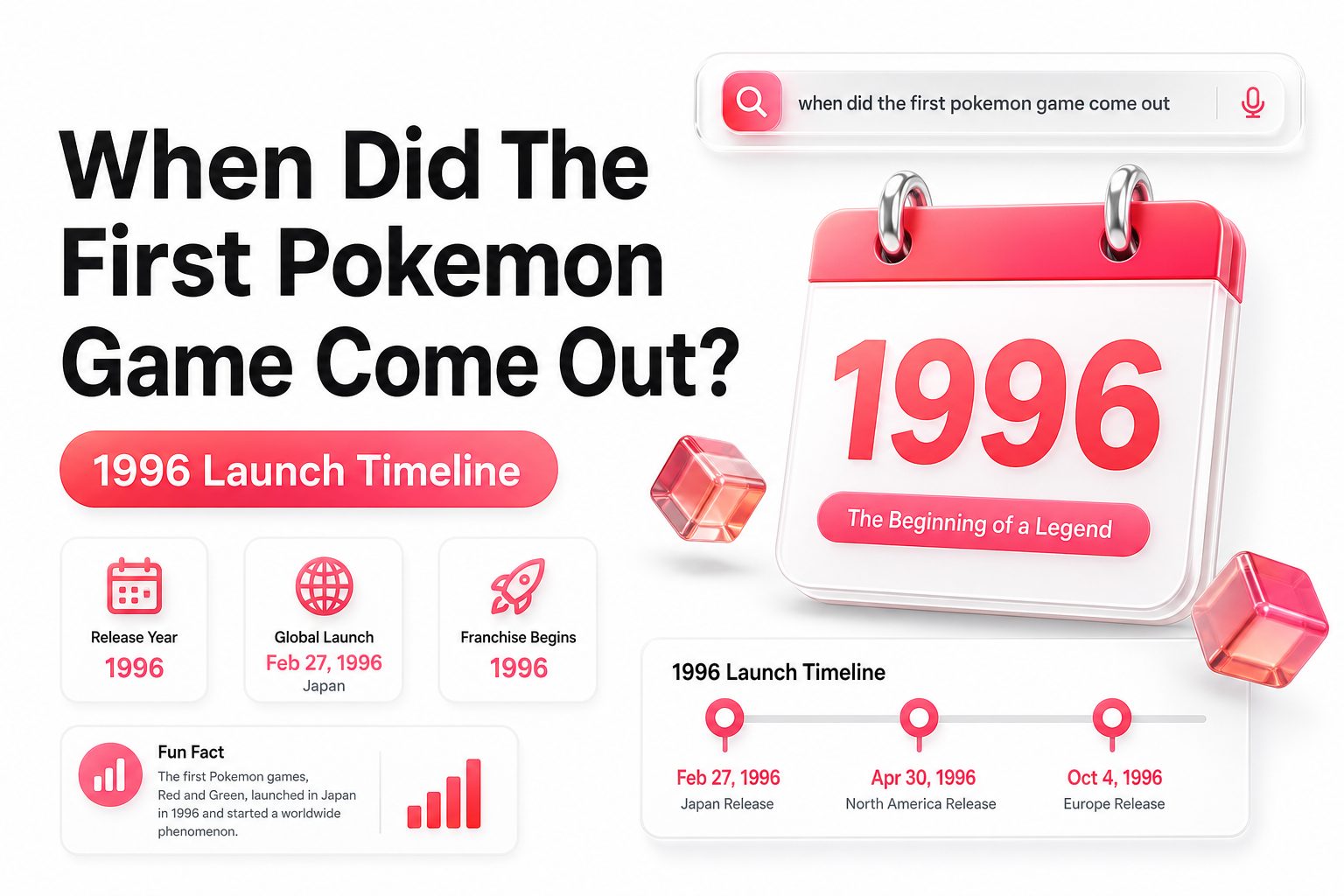
If you have ever wondered when did the first pokemon game come out, the answer takes us back to Japan in the mid-1990s, before Pikachu became a worldwide mascot and before Pokemon cards filled school binders. The original games, Pokemon Red and Pokemon Green, were released for the Nintendo Game Boy on February 27, 1996, in Japan.
That date marked the beginning of one of the most successful entertainment franchises ever made. What started as a handheld role-playing game about catching, training, and trading creatures became a global brand spanning video games, anime, trading cards, films, toys, and competitive events. The first Pokemon games were modest in presentation, but their design was clever, social, and perfectly suited to the Game Boy era.
The First Pokemon Game Release Date
The first Pokemon games came out in Japan on February 27, 1996. Nintendo released Pokemon Red and Pokemon Green for the original Game Boy, giving Japanese players the first chance to explore the Kanto region and catch the original 151 Pokemon.
These games were developed by Game Freak and published by Nintendo. They introduced many features that still define the series, including starter Pokemon, turn-based battles, Gym Leaders, evolution, trading, and version-exclusive creatures that encouraged players to connect with friends.
Why Pokemon Red and Green Came First
Pokemon Red and Green were the original Japanese releases, while Pokemon Blue arrived later in Japan as an improved version. Many players outside Japan know Pokemon Red and Blue better because those were the versions released internationally.
The naming difference often causes confusion. In Japan, Red and Green started the franchise. In North America, Pokemon Red and Blue launched the series on September 28, 1998, using improvements from Japan’s Pokemon Blue while keeping the paired-version format.
Key Facts About the First Pokemon Games
- First release date: February 27, 1996
- First country: Japan
- First versions: Pokemon Red and Pokemon Green
- Original platform: Nintendo Game Boy
- Developer: Game Freak
- Publisher: Nintendo
- Setting: Kanto region
- Original Pokemon count: 151
- International debut: Pokemon Red and Blue in 1998
How the Original Pokemon Games Were Created
Pokemon began as an idea from Satoshi Tajiri, who loved collecting insects as a child. He imagined a game where players could collect creatures and trade them through the Game Boy Link Cable, turning a solo handheld device into a social gaming tool.
Game Freak spent years developing the concept. The project was not an instant certainty, and the Game Boy was already aging by the time Pokemon launched. That made the success of Red and Green even more notable because the games revived interest in Nintendo’s handheld system.
The Role of the Game Boy Link Cable
The Link Cable was central to Pokemon’s design. Some Pokemon appeared in only one version, which meant players had to trade with someone who owned the other game. This turned collecting every Pokemon into a shared goal rather than a purely individual task.
Battling through the Link Cable also gave the game long-term value. Players could compare teams, test strategies, and build stronger lineups after finishing the story. That social layer helped Pokemon spread through schools, neighborhoods, and gaming communities.
Pokemon Release Timeline Comparison
Version | Region | Release Date | Platform
Pokemon Red and Green | Japan | February 27, 1996 | Game Boy
Pokemon Blue | Japan | October 15, 1996 | Game Boy
Pokemon Red and Blue | North America | September 28, 1998 |
Pokemon Yellow | Japan | September 12, 1998 | Game Boy
Pokemon Yellow | North America | October 19, 1999 | Game Boy
Pokemon Red and Blue in North America
Pokemon reached North America more than two years after its Japanese debut. Pokemon Red and Blue launched on September 28, 1998, bringing the series to English-speaking audiences and quickly becoming a major hit for Nintendo.
The timing worked perfectly with the Pokemon anime, trading card game, and toy lines. Children who watched Ash and Pikachu on television could then play a similar adventure on Game Boy, making the games feel connected to a larger world.
How the Western Release Changed Pokemon
The North American release adjusted names, translations, and presentation for English-speaking players. Many Pokemon names became memorable wordplays, such as Charmander, Squirtle, and Bulbasaur, helping the creatures feel approachable and easy to remember.
Nintendo also marketed the games heavily around the “Gotta Catch ’Em All” slogan. That phrase matched the design perfectly because the game was built around collecting, trading, and completing the Pokedex with help from other players.
The Importance of Pokemon Yellow
Pokemon Yellow was released after Red, Green, Blue, and the anime’s rise. It gave players Pikachu as a starter and made the game feel closer to the television series, with Jessie and James appearing as Team Rocket characters.
Although Yellow was not the first Pokemon game, it became many fans’ first experience with the series. Its closer connection to the anime helped deepen Pokemon’s popularity and gave Nintendo another strong Game Boy release.
Notable Differences in Pokemon Yellow
- Pikachu follows the player outside its Poke Ball.
- Players cannot choose Bulbasaur, Charmander, or Squirtle at the start.
- All three original starters can be obtained later in the game.
- Team Rocket’s Jessie and James appear in certain battles.
- Some Pokemon sprites and locations were updated.
- The game was more closely tied to the anime’s popularity.
Why the First Pokemon Game Became So Popular
The first Pokemon games succeeded because they combined simple controls with deep collecting and team-building systems. Players could enjoy the story casually or spend hours training, trading, evolving Pokemon, and searching for rare encounters.
The games also gave players a strong sense of ownership. Choosing a starter Pokemon, naming captured creatures, building a team, and deciding battle strategies made each playthrough feel personal, even though everyone began in the same town.
The Original 151 Pokemon
The first generation introduced 151 Pokemon, from Bulbasaur to Mew. This limited but varied roster made the world feel large without becoming overwhelming. Each creature had its own type, moves, evolution path, and role in battle.
The mystery around Mew added to the games’ appeal. Rumors spread quickly among players, and many children traded stories about hidden tricks, secret locations, and rare Pokemon. That playground mythology helped keep the games alive long after release.
What Made Generation One Stand Out
- A simple goal that was easy to understand
- A large creature roster for the time
- Version exclusives that encouraged trading
- Memorable starter choices
- Strong rival battles throughout the story
- A clear Gym Leader progression system
- Hidden secrets, rare Pokemon, and post-game goals
- A social design built around real-world friends
The Legacy of Pokemon Red and Green
Pokemon Red and Green set the foundation for every mainline Pokemon game that followed. Later entries added color, breeding, held items, abilities, online trading, 3D graphics, open-world areas, and hundreds of new Pokemon, but the core idea remained familiar.
Players still choose a starter, battle trainers, catch wild Pokemon, earn badges, and build a team. That lasting structure shows how strong the original formula was, even with the Game Boy’s limited screen, sound, and storage capacity.
How Pokemon Became a Multimedia Franchise
The video games came first, but the franchise quickly expanded. The anime began in Japan in 1997, followed by the trading card game, manga, toys, movies, and merchandise. Each part supported the others and kept Pokemon in public view.
This wider strategy helped Pokemon become more than a game series. Fans could play on Game Boy, watch episodes on television, collect cards, trade with friends, and buy favorite character merchandise, all tied to the same world.
Tips for Playing the Original Pokemon Games Today
- Start with Bulbasaur for an easier early-game path.
- Choose Charmander if you want more challenge at the beginning.
- Catch a variety of types instead of relying on one strong Pokemon.
- Use status moves like Sleep Powder and Thunder Wave for tough battles.
- Trade if possible to complete more of the Pokedex.
- Keep an Electric-type ready for Water and Flying opponents.
- Save before legendary encounters.
- Try Pokemon Yellow if you want a version closer to the anime.
Where New Players Can Start
New players who want the earliest experience can still play original cartridges, though working copies can be expensive. Digital releases have also appeared on Nintendo systems in the past, making the classics easier to revisit during certain hardware generations.
Modern remakes offer another route. Pokemon FireRed and LeafGreen on Game Boy Advance retell the Kanto adventure with improved visuals and mechanics. Pokemon Let’s Go Pikachu and Let’s Go Eevee also revisit Kanto with simplified catching and a style influenced by Pokemon Yellow.
Original Games Versus Remakes
The original Game Boy titles have historical charm, but they also include old mechanics that may feel rough today. Limited bag space, slower movement, and simpler visuals are part of their identity, though not always convenient for modern players.
Remakes are smoother and more accessible, especially for younger fans. Still, the original Red, Green, Blue, and Yellow versions remain important because they show the series before decades of additions changed its pace, systems, and presentation.
Best Options for Different Players
Player Type | Best Choice | Reason
History-focused fan | Pokemon Red or Green | Closest to the
English-speaking classic fan | Pokemon Red or Blue | First
Anime fan | Pokemon Yellow | Pikachu follows the player
Modern newcomer | FireRed or LeafGreen | Classic Kanto with
Casual Switch player | Let’s Go Pikachu or Eevee | Easy
Common Confusion About the First Pokemon Game
Many people think Pokemon Red and Blue were the first Pokemon games because those were the first versions released in North America and many other regions. That is true for international players, but not for the franchise as a whole.
The correct global answer is Pokemon Red and Green in Japan. The correct North American answer is Pokemon Red and Blue in 1998. Both facts matter because Pokemon’s release history changed depending on region.
Why Pokemon Green Was Not Released in North America
Pokemon Green did not come to North America under that name because the international releases were based more closely on Japan’s updated Pokemon Blue version. Nintendo chose Red and Blue as the paired titles for Western markets.
That decision gave overseas players a more polished version of the original games. While Green stayed tied to Japanese history, Blue became the familiar counterpart to Red for many fans outside Japan.
Important Regional Release Notes
- Pokemon Green was one of the first two Japanese games.
- Pokemon Blue in Japan was an enhanced third version.
- International Pokemon Red and Blue used improvements from the Japanese Blue release.
- Pokemon Green did not receive a standard North American Game Boy release.
- Pokemon Yellow followed after the anime made Pikachu the franchise mascot.
How the First Pokemon Game Shaped RPG Design
The first Pokemon games made role-playing mechanics more approachable for a broad audience. Turn-based battles, leveling, elemental strengths, and party management were presented through colorful creatures rather than dense fantasy systems.
The games also made collection a central RPG mechanic. Catching Pokemon was not a side activity; it was the main identity of the experience. That focus influenced later monster-collecting games and helped define a lasting subgenre.
The Cultural Impact of the 1996 Release
The Japanese launch in 1996 did not just start another Nintendo series. It created a cultural force that shaped childhood gaming in the late 1990s and early 2000s across multiple countries.
Pokemon became a shared language among players. Knowing evolutions, trading version exclusives, debating starters, and memorizing type matchups were all part of the social experience. Few handheld games have matched that level of everyday cultural presence.
Key Takeaways for Searchers
- The first Pokemon game came out in Japan on February 27, 1996.
- The first versions were Pokemon Red and Pokemon Green.
- Pokemon Red and Blue launched in North America on September 28, 1998.
- The original games were made for the Nintendo Game Boy.
- Game Freak developed the games, and Nintendo published them.
- The first generation introduced the Kanto region and 151 Pokemon.
- Trading through the Link Cable was a major reason the games became social hits.
Why the Release Date Still Matters
The 1996 release date matters because it marks the start of a franchise that continues to shape gaming. Every anniversary, remake, and new generation connects back to the Game Boy titles that first introduced catching and trading Pokemon.
It also helps clear up release confusion. Fans in different regions often remember different “first” games, depending on where they grew up. Knowing the Japanese and international timelines gives a more accurate view of Pokemon history.
Pokemon’s Place in Nintendo History
Pokemon became one of Nintendo’s most valuable franchises, standing beside Mario and The Legend of Zelda. Its success helped extend the life of the Game Boy and gave Nintendo a powerful handheld identity heading into later systems.
The franchise also proved that handheld games could create massive global communities. Before online trading became normal, Pokemon used cables, local play, schoolyard swaps, and real-world conversation to make portable gaming feel connected.
Related Reading
For more background on classic Nintendo releases, see [Internal Link: Nintendo Game Boy History].
For a closer look at the creatures that started it all, visit [Internal Link: Original 151 Pokemon List].
Conclusion
The answer to when did the first pokemon game come out is February 27, 1996, when Pokemon Red and Pokemon Green launched in Japan for the Nintendo Game Boy. Those two games introduced the Kanto region, the original 151 Pokemon, and the trading system that made the series feel social from the start.
International fans often remember Pokemon Red and Blue as the beginning because those versions arrived in North America on September 28, 1998. Both milestones matter, but the franchise began with Red and Green in Japan.
What made the first games special was not advanced graphics or technical power. It was the simple pleasure of catching creatures, building a team, trading with friends, and chasing a full Pokedex. That formula proved strong enough to support decades of games, shows, cards, and memories.
FAQ
What were the first Pokemon games
The first Pokemon games were Pokemon Red and Pokemon Green. They were released in Japan for the Nintendo Game Boy on February 27, 1996, before Pokemon Red and Blue launched internationally.
When did Pokemon come out in America?
Pokemon Red and Blue came out in North America on September 28, 1998. These were the first Pokemon video games officially released for American players.
Why was Pokemon Green not released in America?
Pokemon Green was not released in America as a standard Game Boy title because international versions used improvements from Japan’s Pokemon Blue. Nintendo chose Red and Blue for the Western paired release.
Was Pokemon Yellow the first Pokemon game?
No, Pokemon Yellow was not the first Pokemon game. It came after Red, Green, and Blue, and was designed to connect more closely with the anime by featuring Pikachu as the player’s partner.
Who created the first Pokemon game?
The first Pokemon games were created by Game Freak, with Satoshi Tajiri credited as the original creator. Nintendo published the games, and Creatures also became closely tied to the franchise’s development.
0 Comments